

Most car parks in Brisbane need sweeping 1-3 times per week, depending on traffic and property type. Getting it wrong costs you money down the track and affects safety and compliance.
Imagine that you’re walking through your shopping centre car park on Monday morning, and there’s rubbish everywhere from the weekend rush. Food wrappers are scattered near the entrance, leaves are piling up in the corners, and there are oil stains that weren’t there last week.
Now your tenants are complaining, and you’re stuck wondering if twice-monthly cleaning is really enough (or if you’re wasting money on too many services).
In this guide, we’ll show you how to figure out the perfect car park sweeping schedule in Brisbane. Additionally, BrisbaneSweeping can help you maintain a spotless and welcoming environment without overspending.
Ready to learn more about car park sweeping in Brisbane? Let’s dig in.
What Factors Determine Your Sweeping Schedule?
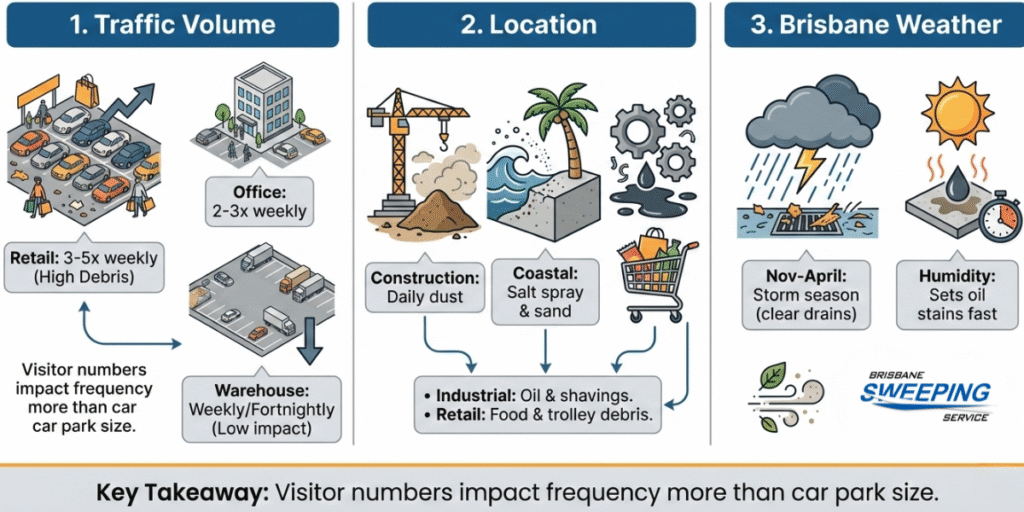
Typically, it comes down to three things: how busy your car park gets, where it’s located, and what Brisbane’s weather throws at it. And understanding these means you’ll stop second-guessing your cleaning frequency.
Let’s break down each one.
Traffic Volume Is Your Biggest Cost Driver
High-traffic retail spaces need sweeping 3-5 times weekly because hundreds of customers track in dirt and drop rubbish daily.
Then, office buildings get by with 2-3 weekly services since the same staff use the spaces regularly. Also, the debris doesn’t pile up as fast.
And finally, low-traffic warehouses where only employees park can manage with weekly to fortnightly cleaning. This is because visitor numbers have a bigger impact on frequency than your car park’s physical size.
Your Location Creates Different Debris Patterns
Near construction sites, you’ll deal with daily dust that gets tracked everywhere. Such as, Coastal areas face salt spray and sand buildup, eating away at concrete. Then, tree-lined car parks bring constant leaf fall, blocking stormwater drains and creating slip hazards.
Beyond these natural causes, your property type creates its own mess. For example, Industrial estates handle oil spills, metal shavings, and pallet splinters from loading operations.
Shopping precincts are different, though. They deal with food wrappers, drink containers, and shopping trolley debris piling up constantly from customer traffic. For example, warehouses in Eagle Farm face completely different challenges compared to Queen Street Mall retail spaces.
Brisbane’s Subtropical Weather Impacts Your Schedule
Storm season (November to April) brings heavy debris and blocked drains needing immediate attention. Thus, property owners must keep drainage systems clear year-round according to Brisbane stormwater requirements.
And during winter, dust control becomes a priority. Plus, Brisbane’s humidity also causes oil stains to set faster into concrete.
How Different Property Types Need Different Schedules
Ever wonder why your competitor’s car park always looks cleaner, even though you both sweep weekly?
It’s because different property types create different messes at different speeds. What works for an office building won’t work for a shopping centre, and treating them the same just wastes your money. So let’s look at what each type needs.
Shopping Centres Face Unique Cleaning Challenges
Shopping centres need sweeping 3-5 times weekly minimum. That’s because you’ve got hundreds (sometimes thousands) of customers visiting daily, and they’re all tracking in dirt and leaving rubbish behind.
Here’s where it gets tricky, though. If you’ve got a 24-hour Coles or Woolworths, you can’t just shut down the car park for cleaning. You’ll need to coordinate sweeping around peak trading hours, which usually means early mornings or late evenings when foot traffic drops.
Weekend traffic creates its own headaches, too. Monday mornings are consistently the worst because debris piles up over Saturday and Sunday when your car park gets hammered. Food court areas need even more attention than general parking spaces since spills and wrappers accumulate faster there.
On top of that, body corporates expect you to maintain a spotless and welcoming environment for their tenants and customers. Fall behind on that standard, and you’ll hear about it in the next meeting.
Office Buildings Have Predictable Patterns You Can Use
Office car parks are easier to manage because the same staff use them Monday through Friday. You’ll notice that Mondays and Fridays are your heaviest debris days. That’s because Monday collects whatever blew in over the weekend, and Friday brings extra rubbish from food deliveries and end-of-week laziness.
A Tuesday and Thursday sweeping schedule works brilliantly for most office buildings. This schedule catches the mid-week buildup without overdoing it. Basically, you’re staying ahead of the mess while keeping costs reasonable.
Multi-level car parks need different equipment than open-air lots, though. Compact sweepers fit better in tight ramps and low-clearance areas where larger machines can’t access properly. You’ll also find that visitor parking zones near building entrances need more frequent attention than staff spaces tucked away in back corners.
After-hours access becomes important here, too. You’ll need to coordinate with building security for entry codes, gate access, and making sure your cleaning team can work without disrupting early arrivals or late workers. Some buildings require a 24-hour notice before sweeping, so factor that into your scheduling.
Experienced cleaners like BrisbaneSweeping understand these local conditions and know how to work around office building schedules without creating hassles for tenants.
Industrial Warehouses Take Heavy-Duty Wear
Industrial facilities face completely different challenges. For instance, Forklift traffic creates wear patterns you won’t see in retail or office spaces. Those machines drop hydraulic fluid, scrape rubber off tyres, and kick up dust constantly throughout the day.
Moreover, loading dock zones are the worst spots. Pallet debris, cardboard scraps, and packaging materials pile up daily from truck deliveries. You’ll also get concrete dust from ongoing operations if any manufacturing or processing is happening on-site.
Weekly deep cleaning handles the bulk of it, but high-activity warehouses often need daily spot maintenance in loading areas. The combination keeps your floors safe without breaking your budget on constant full sweeps.
Here’s what most managers miss, though. Industrial sites can’t use the same cleaning schedules as retail properties. A shopping centre sweep takes 1-2 hours for a standard car park.
But a warehouse with heavy equipment, tight aisles, and pallet racking? That same-sized space takes 3-4 hours because you’re working around operations and dealing with tougher debris.
Warning Signs You Need to Change Your Sweeping Frequency
If you’re seeing these problems, your current schedule isn’t working. Most managers wait until complaints pile up. But by then, you’re dealing with damage that costs money.
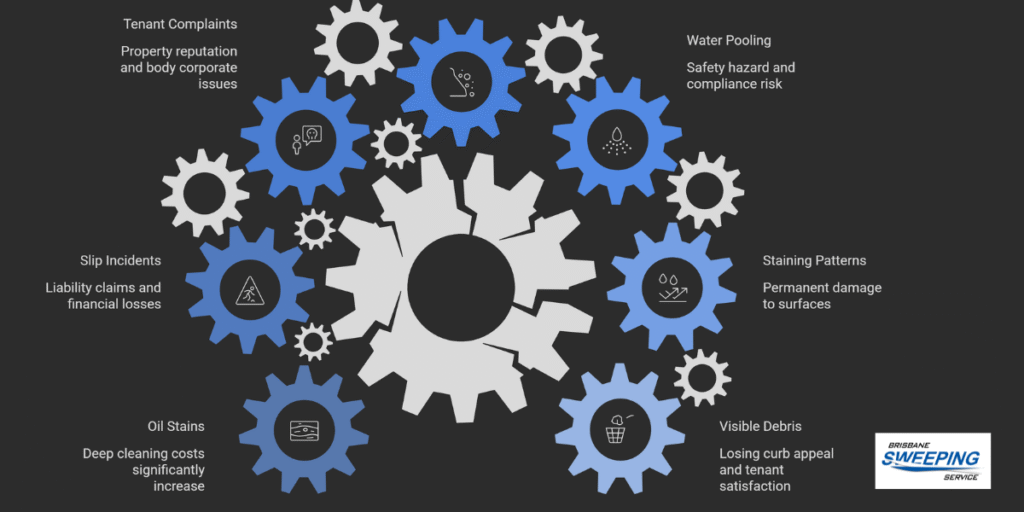
Here’s a quick breakdown of what to watch for:
| Warning Sign | What It Means | Why It Matters |
| Debris visible from the street | Schedule too infrequent | You’re losing curb appeal |
| Staining patterns developing | Gaps between cleans are too long | Permanent damage is setting in |
| Water pooling after rain | Blocked drainage paths | Safety hazard and compliance risk |
| Corner/edge buildup | Sweeper rushing the job | You’re not getting what you paid for |
| Tenant complaints rising | Property reputation declining | Body corporate meetings get ugly |
| Slip and fall incidents | Debris creating hazards | Liability claims cost thousands |
| Oil stains are setting in | Too much time between sweeps | Deep cleaning costs 10x more |
If you’re seeing two or more of these warning signs regularly, it’s time to adjust your frequency before small problems turn into expensive repairs.
The Compliance Angle You Can’t Ignore
According to Safe Work Australia’s slip prevention guidelines and WorkSafe Queensland’s safety obligations, property managers must maintain safe premises and control hazards.
So, a debris-filled car park absolutely qualifies as a hazard you’re responsible for.
What “Good Enough” Looks Like
Your car park should look presentable most of the time visitors arrive. That means minimal debris in high-traffic zones, clear drainage paths you can see, and no permanent staining developing between services.
For instance, a few leaves between sweeps? That’s normal. Visible grime and blocked drains? That’s a problem.
How to Balance Cost vs. Quality (And Actually Save Money)
Smart facility managers know the cheapest sweeping schedule usually costs you more in the long run.
But here’s what tends to happen: You go with the lowest quote, get mediocre service, and end up spending more on repairs than you saved on cleaning.
What Cleaning Services Cost In Brisbane: Based on our experience, contract pricing typically saves you 20-30% compared to ad-hoc rates because providers can schedule more efficiently. Professional operators also use vacuum sweepers with proper dust control instead of push brooms that just move dirt around.
Under-Scheduling Costs You Way More: Asphalt repairs can cost about 10 times more than preventive sweeping would have. Pressure washing to remove set oil stains runs $500-1500 per session. Repainting line markings more often adds up fast, too.
Then there’s the lost business side of things. Shoppers judge retail properties by car park appearance, and a messy one drives people away. Body corporate special levies for emergency cleaning hit everyone’s wallet hard. Slip-and-fall liability claims can run tens of thousands once lawyers get involved.
Now, do you want to test your schedule? Try running a 3-month trial with increased frequency and see what changes. Take weekly photos to document improvements objectively. Then, track complaints before and after. Most properties see complaints drop significantly within the first month of more frequent cleaning.
There’s also a simple calculation you can do: Divide your monthly spend by the number of spaces you have. If you’re spending under $2 per space each month, you’re probably underserving your property.
Getting Your Schedule Right From Day One
Now that you understand what affects sweeping frequency, here’s how you can put it into action.
Traffic volume, location conditions, property type, and Brisbane’s subtropical weather all determine what your car park needs. Besides that, high-traffic retail spaces need 3-5 weekly services, offices get by with 2-3 times, and warehouses can manage weekly to fortnightly cleaning.
We recommend starting with a simple test. Walk through your car park on day 1 after cleaning, then again on days 3 and 7. If it looks rough by day 3, you need more frequent cleaning. Still presentable at day 7? You might be over-servicing.
Professional sweeping teams like BrisbaneSweeping offer free site assessments to help you find the right balance between appearance, safety, and budget. They’ll evaluate your specific property and recommend a schedule that actually works for your situation.
Getting the frequency right from the start saves you money, keeps tenants happy, and protects your property investment for years to come.
